Tuesday, February 28, 2017

WikiHow Experience

WikiHow.com is a website for anyone who has the desire to learn how to do literally anything. From cooking recipes to learning a new language, this is the place for anyone looking for a step-by-step process into something new. It’s impossible to go on the website and not find anything fascinating to learn because of the different variations of topics that is quite useful for everyone. Even if an idea seems too outrageous to be online, most likely someone else thought of it and decided to make a WikiHow page on it. Variety is just an understatement of a word to describe the endless topics to find on WikiHow and the different ways to get successful results. Some common topics that can be found on the website are DIY’s or “Do-It-Yourself” tutorials with items found at home. DIY’s can range from constructing home décor with old furniture or reusing kitchen appliances for new business venture. The concept of DIY’s have been around for years however, with sites like Pintrest and WikiHow it makes it easier for people to be resourceful and also learn something new. A DIY that is easy and super inventive is the home-made face mask and toner which includes honey, cinnamon powder, baking soda and apple cider vinegar, products that are typically found in the kitchen.
Throughout the process of making the mask and toner there were several ways to communicate this Wiki topic from personal experience, following instructions online and speaking to others about the topic itself. A DIY face mask and toner went along the lines of a cooking recipe without actually cooking and eating. Before creating a WikiHow page, this mask was used numerous times to combat recurring acne flare ups and the dreaded blackhead scars that follow it. Store bought products are always an option for those who don’t have the patience to make their own mask and toner. However, the issue with that is often no one knows the ingredients that are included in these products and not aware how harmful it may be for their skin. Specific DIY masks and toners may not work for everyone which is why it is encouraged for people to find out their personal allergies so it doesn’t break them out. By making a WikiHow page, the method used to make the mask and toner had to be improved and personalized. The ingredients used before making the Wiki page were just honey and cinnamon powder without accurate measurements. After doing further research online, it was discovered that there were different variations of the same mask with other components such as olive oil and sugar. There are countless honey and cinnamon DIY WikiHow pages so by adding other ingredients made it more personal and fun. With the improvements and added elements to the mask, the items used to make it were raw honey, cinnamon powder, baking soda, tea tree oil, and fresh lemon. For the best results, it is suggested to get organic products such as raw honey and concentrated tea tree oil when making the mask and toner because it produces better results. After using other Wiki pages as a blueprint for the mask, it was apparent that store bought products were not a necessity for healthy and clean skin.
After putting on the face mask and washing it off the toner had to be applied to finish the entire process. Face toners not hydrates the skin after washing the mask off but it also gives a luminesce finishing glow. Facial toners are mainly water based that removes oils and smooths the face altogether. During the process of making the toner, it was clear that accurate measurements were required depending on the level of skin sensitivity. Organic apple cider vinegar and water were the main ingredients needed to make the toner successful. However, after adding personal oils such as tea tree and coconut oil to the toner itself made it even better. There are countless articles online how to make a face toner with apple cider vinegar, water and tea tree oil. After doing further research online, it was found that coconut oil is used for many home remedies and it would make the toner more effective. From online websites, it was discovered that there were different variations of facial toners including witch hazel with vitamin c and herbal tea with aloe Vera gel.  For this assignment, the goal was to recreate a face toner with the ingredients in a kitchen cabinet already. Everyone has tea in their kitchen for their own personal reason whether it be for a common cold, or just for leisure, tea contains supplements that are not only beneficial for inside the body but outside as well. Green tea has numerous benefits for the skin such as antioxidants that prevent wrinkles, fine lines, age spots, sun damage and sagging which can delay signs of aging. By adding green tea as an ingredient to the face toner, it will make the final product enriched with nutrients. The information from other Wiki pages helped make the toner by using them as a guideline and adding personal touches. Photos from online also made the process easier to do since there were examples on websites that showed what the face mask and toner should look like. With personal touches, the face mask and toner pretty much looked the same as the online examples.

One of the biggest things to keep in mind when making the face mask and toner is to follow the instructions online as it shows or the finished product will not be what it’s supposed to look like. Failure to follow specific instructions will only result in redoing the entire process over for accuracy. DIY projects are fun and exciting however, they can be quite tedious and aggravating if it’s not done properly. All natural and homemade DIY products prove to be the best route in terms of a healthier life style and economically fitting. The honey cinnamon tea tree oil face mask and toner is meant to inspire others to not only use it but make their own instead of buying it in a store with unknown ingredients.
Links: https://www.wikihow.com/index.php?title=Honey-Cinnamon-Tea-Tree-Oil-Mask-and-Face-Toner&oldid=21952086
https://www.wikihow.com/Make-a-Skin-Toner


Sunday, February 5, 2017

In a Different World: The World Wide Web

The World Wide Web According to Me

I was born in 1995, the middle of the 90s and the midst of what we know as Web 1.0. Basically, when people still used landline phones and had to disconnect it to use the Internet. I'm not familiar with Web 1.0 (thankfully) because I grew up when Web 2.0 was developed and launched. In my own terms, Web 2.0 is the connection between social media sites and the World Wide Web. With Web 2.0, users are in control of everything and there is way more stuff to do rather than Web 1.0. In my opinion, Web 3.0 is a more advanced version of Web 2.0 by using the data in your history to tend to your personal needs. I was not aware we were in the Web 3.0 era until I realized that it is based on your personal data collection and I'm not sure how to feel about it. (Evolution of the Webs) From reading this article, I realized we may be too advanced for Web 2.0 as technology progresses daily and we move right along with it. As an avid user of the Internet, Web 2.0 isn't as fast as we thought it was in regards to "technological intelligence" and it has the tendency of giving us too much information when using search engines, often times information we don't need. Web 2.0 changed how we look at the World Wide Web as a whole by giving each person who accessed it more control and being able to communicate with millions of people with one button. It is known as the largest jump in evolutions because of the amount of innovations within the last ten years, the way society communicates with one another will never be the same. Web 2.0 made it possible to do things like meet someone in another country and build a friendship by using social media sites. It also made it easier to learn a new language and build your brand from the comfort of your own home thanks to sites like Youtube! Web 2.0 broke down the barriers that were once there with Web 1.0 and created a new way of thinking within our society. By Web 2.0 being developed it has opened doors in terms of employment, relationships, and networking and that's what technology is about: advancing to the next level. Although there are many harmful effects from using Web 2.0 such as invasion of privacy and lack of human interaction, this is only happening because people ruin great inventions like this. The point of social media is to connect people and create closer bonds, but now it's an argument whether or not it has killed social interaction. Supposedly we have transitioned from Web 2.0 to Web 3.0 and this raises many questions in my head. Why is it so important to have access to MY personal data to "fit" my needs? I understand the premise of Web 3.0 however, it bothers me when I just ordered shoes online and when I go on Facebook I see an ad on the side promoting the same shoes I just ordered! This is one of the disadvantages of Web 3.0, there's always a scheme to get you to buy something even when you you just looking something up. Instead of linking people, it links your data which is kind of creepy. Some benefits of Web 3.0 would be that it tailors to your personal taste making it feel like it "knows" you based on your history. It's like the guy  you like remembering the cute little things about you that you swore he wasn't paying attention to. Another great thing about it is not only does it center around you but it connects you with people who have similar interest as you.

From the Inside Looking Out: The Wild Wild World Wide Web

Some would like to call Web 1.0 the dinosaur era, computers screens weren't so flat with thick backs, high speed Internet was nonexistent, and users had no way of communicating with others unless they picked up the phone. Also referred to as the read-only era, Internet users could only read information that was presented in front of them.When Web 1.0 first came around there were about 250,000 websites and 45 million users worldwide in 1996. That may seem like a lot of people at the time, but many people didn't have access to computers or even afford them at the time. In the 1990s, computers were just introduced as the next big thing and who knew it would a necessity to be successful? When users accessed the Internet they were limited to what they could do online, leaving the World Wide Web very closed off. This was the surface of the World Wide Web and after Web 2.0 was developed and launched in 1999, the cyber world would never be the same. Web 2.0 was the next level of technology that took interactive between Internet users to higher levels. Ten years later the number of websites increases to 80 million with 1 billion users globally with the help of Web 2.0. In this time period, social media accelerated in numbers with websites such as Youtube, MySpace, Google+, Flikr, and Facebook. According to The Future Buzz, there were approximately 1 trillion unique Google URLs and over 2 billion Google searches in 2009 alone As time progressed, the amount of Internet users increased because of the amount of accessibility Web 2.0 allowed people to take control of their image online and by doing so it opened doors of communication across the world. During this time blogging, vlogging (video-blogging), online streaming, liking/commenting granted online users to collaborate and connect in just a click. Fast forward to 2016, there are ten times as many websites (800 million) with an outstanding 8 billion+ Internet users globally (Web Statistics). With the the rapid growth of technology, Web 3.0 has taken the modifications of both Web 1.0 and 2.0 and made the World Wide Web even smaller. Web 3.0 offers way more in terms of Web intelligence and is way more personal than ever before. Because 2.0 caused a lot of "information overload." 3.0 narrows down to the specifics of individual needs and offers many solutions. Web 3.0 also offers 3D websites which is what many technology companies are buying more into as technology enhances everyday. By shopping online for something as simple as a new coat, not only will various websites will pop up but coats that may fit the person's style or budget will make it easier to find the exact item.
The evolution of Web 1.0, 2.0, and 3.0 is simply living proof that as time progressed, technology progressed with it. Now in 2017, it is believed that society is in the Web 4.0 phase.  This is where technology will be able to detect who the individual is by the front face camera. Snapchat for example, has face filters where users the front camera detects the user and they are able to change to cartoon drawings. This is a fun interactive way for users to be introduced into the future of social media and technology as a whole. 

Friday, January 27, 2017

Many Impacts of Social Media

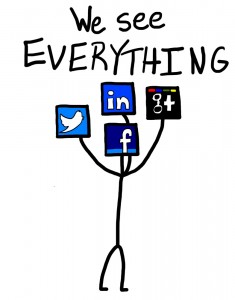
      I will be the first to admit, I am addicted to social media and I'm okay with that. I would like to consider myself what you would call a "social network junkie." Facebook, Twitter, Tumblr,  Instagram, and especially SnapChat, I use them all on a daily basis and I couldn't imagine not using any of them. As a certified social network junkie, I must admit that I feel as though it is intrusive into people's personal lives because anything posted online is accessible and never goes away.   Although all social media sites have their own set of privacy settings, it is not guaranteed that your personal information will not go public. 
     While being active on any social media site, it is imperative to be responsible of what you post because you never know who is watching you online. Facebook is currently the most used social network site on the planet with over one billion visitors monthly. Out of that billion, it's a strong possibility that your current or future employer is using it as well and will use it to their advantage. I can't remember the amount of times my mom has told me to be careful of what I post online especially on Facebook because people are able to still see what I post even if my information is "private". Which means to make sure your profile picture is decent (no nudity, drugs or alcohol), don't make post too personal so the whole world knows what I'm going through, refrain from posting everything that occurs in my life online and blah blah blah. After the 100th time, I finally listened to her and cleaned my Facebook page because mom knows best right? Although it's important to be mindful of what we post online, does it really matter? There are numerous stories and accusations against social network sites that use your information without your information, even if it's supposedly "private". 
      In August 2013, a class-action suit that lasted two years was settled in favor of Facebook, with the consent of the court, of making a profit of exploited children without their knowledge or their parents. A mother found a picture of her daughter in an online ad one scrolling through Facebook and drew the line. Despite it being prohibited in six states (California, Florida, New York, Oklahoma, Tennessee, Virginia and Wisconsin), many parents felt like it was a slap in the face. For example, if a child checks in at a restaurant, there's a possibility that an ad with that child's face will appear along with the restaurants name as a form of advertising. No matter what privacy is privacy and if someone does not give you permission to use their information than you simply shouldn't. 
       In the near future I see social media as the only form of communication. Right now, we are able to send messages, place phone calls, and even send money through social media sites. As exciting as it is to see what else is out there, I will always miss the days when people actually socialized and used their social network accounts... the good days.